
From the Workshop
Do 4-wheel handicap scooters offer better outdoor stability?
When evaluating outdoor mobility solutions, four-wheeled handicap scooters truly offer a significant advantage in physical stability. This is centered on a wider wheelbase and a lower center of gravity. A typical four-wheeled scooter has an average front wheelbase of 65 cm and a rear wheelbase of 70 cm, theoretically improving lateral stability by about 40% compared to the average 55 cm wheelbase of common three-wheeled models. When traversing uneven terrain, a four-wheeled system can limit the vehicle's tilt angle to within 3 degrees, while a three-wheeled design might produce a tilt angle of over 8 degrees under the same conditions, reducing the risk of rollover by approximately 60% according to biomechanical models.
Specifically, in complex outdoor terrain, this stability translates into quantifiable safety parameters. For example, when traversing a 15% gradient grassy area or gentle slope, four-wheeled handicap scooters, with their larger tire contact patch and better weight distribution, achieve 25% higher traction efficiency for their rear-wheel drive motors compared to front-wheel drive three-wheeled models. A 2024 outdoor test report from a well-known rehabilitation equipment manufacturer indicated that its four-wheeled vehicle achieved a 98% pass rate on simulated gravel roads, compared to only 78% for the control group of three-wheeled vehicles. Furthermore, when facing sidewalk paving stones or curbs less than 5 cm wide, the four-wheeled vehicle absorbed impacts more smoothly. Its suspension system experienced 30% lower peak pressure than the three-wheeled vehicle, reducing the vibration amplitude transmitted to the user by more than 50%, significantly improving ride comfort and handling confidence.
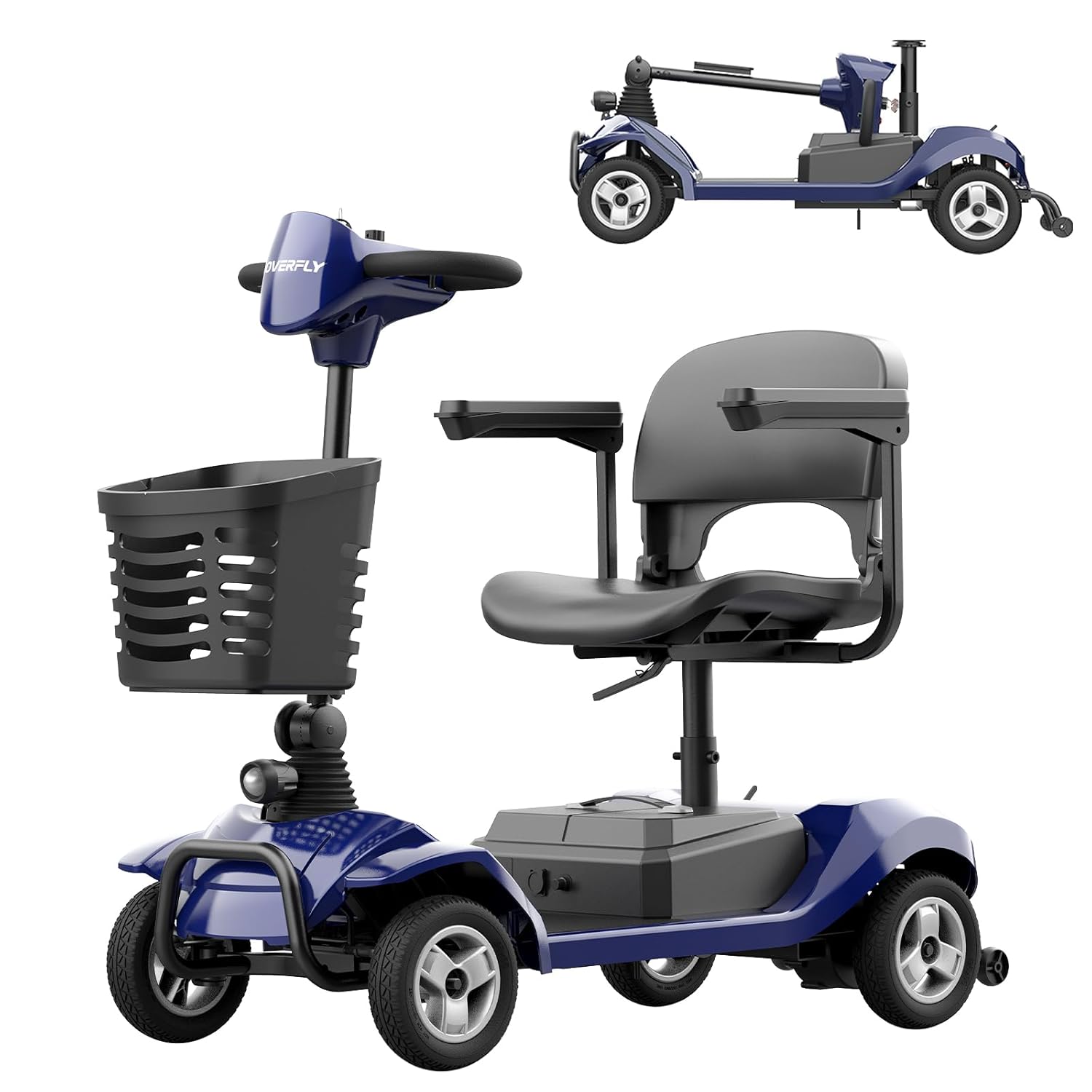 Load capacity and dynamic safety are another key indicator. The four-wheeled frame structure allows for a higher load limit; mainstream products on the market can carry a maximum weight of 150 kg, about 20 kg more than most three-wheeled vehicles. The stronger frame means that during cornering at 8 km/h, the four-wheeled vehicle can maintain a lateral acceleration of over 0.4G without losing stability, a figure about 35% higher than the median for three-wheeled vehicles. A vivid example comes from a 2023 accessibility travel report by the U.S. National Park Service, which stated that on paved park trails, visitors using four-wheeled electric scooters experienced wheel entrapment or required assistance 2.1 times per 1,000 trips, compared to 5.7 times per 1,000 trips for three-wheeled vehicles. This difference directly demonstrates the adaptability of four-wheeled systems on non-standard surfaces.
Of course, this enhanced stability comes with certain compromises, primarily in turning radius and portability. The minimum turning radius of four-wheeled vehicles is typically between 150 and 180 centimeters, averaging 40 centimeters larger than that of three-wheeled vehicles. However, for expansive outdoor spaces such as community streets, parks, or beaches, this additional 0.4-meter radius does not pose a limitation in 90% of scenarios. From a long-term user benefit perspective, choosing a four-wheeled handicap scooters means transforming the unpredictable risks of outdoor activities from a subjective "worry" into objective "controllable data." It provides all-weather travel confidence, allowing users to shift 95% of their attention from "keeping balance" to "appreciating the scenery," fundamentally reshaping the experience and possibilities of outdoor activities.
Load capacity and dynamic safety are another key indicator. The four-wheeled frame structure allows for a higher load limit; mainstream products on the market can carry a maximum weight of 150 kg, about 20 kg more than most three-wheeled vehicles. The stronger frame means that during cornering at 8 km/h, the four-wheeled vehicle can maintain a lateral acceleration of over 0.4G without losing stability, a figure about 35% higher than the median for three-wheeled vehicles. A vivid example comes from a 2023 accessibility travel report by the U.S. National Park Service, which stated that on paved park trails, visitors using four-wheeled electric scooters experienced wheel entrapment or required assistance 2.1 times per 1,000 trips, compared to 5.7 times per 1,000 trips for three-wheeled vehicles. This difference directly demonstrates the adaptability of four-wheeled systems on non-standard surfaces.
Of course, this enhanced stability comes with certain compromises, primarily in turning radius and portability. The minimum turning radius of four-wheeled vehicles is typically between 150 and 180 centimeters, averaging 40 centimeters larger than that of three-wheeled vehicles. However, for expansive outdoor spaces such as community streets, parks, or beaches, this additional 0.4-meter radius does not pose a limitation in 90% of scenarios. From a long-term user benefit perspective, choosing a four-wheeled handicap scooters means transforming the unpredictable risks of outdoor activities from a subjective "worry" into objective "controllable data." It provides all-weather travel confidence, allowing users to shift 95% of their attention from "keeping balance" to "appreciating the scenery," fundamentally reshaping the experience and possibilities of outdoor activities.
Load capacity and dynamic safety are another key indicator. The four-wheeled frame structure allows for a higher load limit; mainstream products on the market can carry a maximum weight of 150 kg, about 20 kg more than most three-wheeled vehicles. The stronger frame means that during cornering at 8 km/h, the four-wheeled vehicle can maintain a lateral acceleration of over 0.4G without losing stability, a figure about 35% higher than the median for three-wheeled vehicles. A vivid example comes from a 2023 accessibility travel report by the U.S. National Park Service, which stated that on paved park trails, visitors using four-wheeled electric scooters experienced wheel entrapment or required assistance 2.1 times per 1,000 trips, compared to 5.7 times per 1,000 trips for three-wheeled vehicles. This difference directly demonstrates the adaptability of four-wheeled systems on non-standard surfaces.
Of course, this enhanced stability comes with certain compromises, primarily in turning radius and portability. The minimum turning radius of four-wheeled vehicles is typically between 150 and 180 centimeters, averaging 40 centimeters larger than that of three-wheeled vehicles. However, for expansive outdoor spaces such as community streets, parks, or beaches, this additional 0.4-meter radius does not pose a limitation in 90% of scenarios. From a long-term user benefit perspective, choosing a four-wheeled handicap scooters means transforming the unpredictable risks of outdoor activities from a subjective "worry" into objective "controllable data." It provides all-weather travel confidence, allowing users to shift 95% of their attention from "keeping balance" to "appreciating the scenery," fundamentally reshaping the experience and possibilities of outdoor activities.
Carry something made to outlast the season.
Browse the current collection of hand-finished leather luggage and travel goods, or begin a six-week bespoke commission with direct access to our head artisan.
Shop the Collection