
From the Workshop
Before the First Call: Preparing to Brief Chinese Scent Materials
The first call about Chinese scent materials is not where you discover what you want; it is where you test whether you can describe it. Buyers who arrive with a prepared packet — references, three material directions, a format decision and a festive date — get a productive conversation about feasibility. Buyers who arrive with an enthusiasm for the idea get a pleasant conversation that costs them a sample round. The preparation is not complicated, but it is specific, and it is the same preparation whether you are briefing one partner or comparing three.
Key takeaways
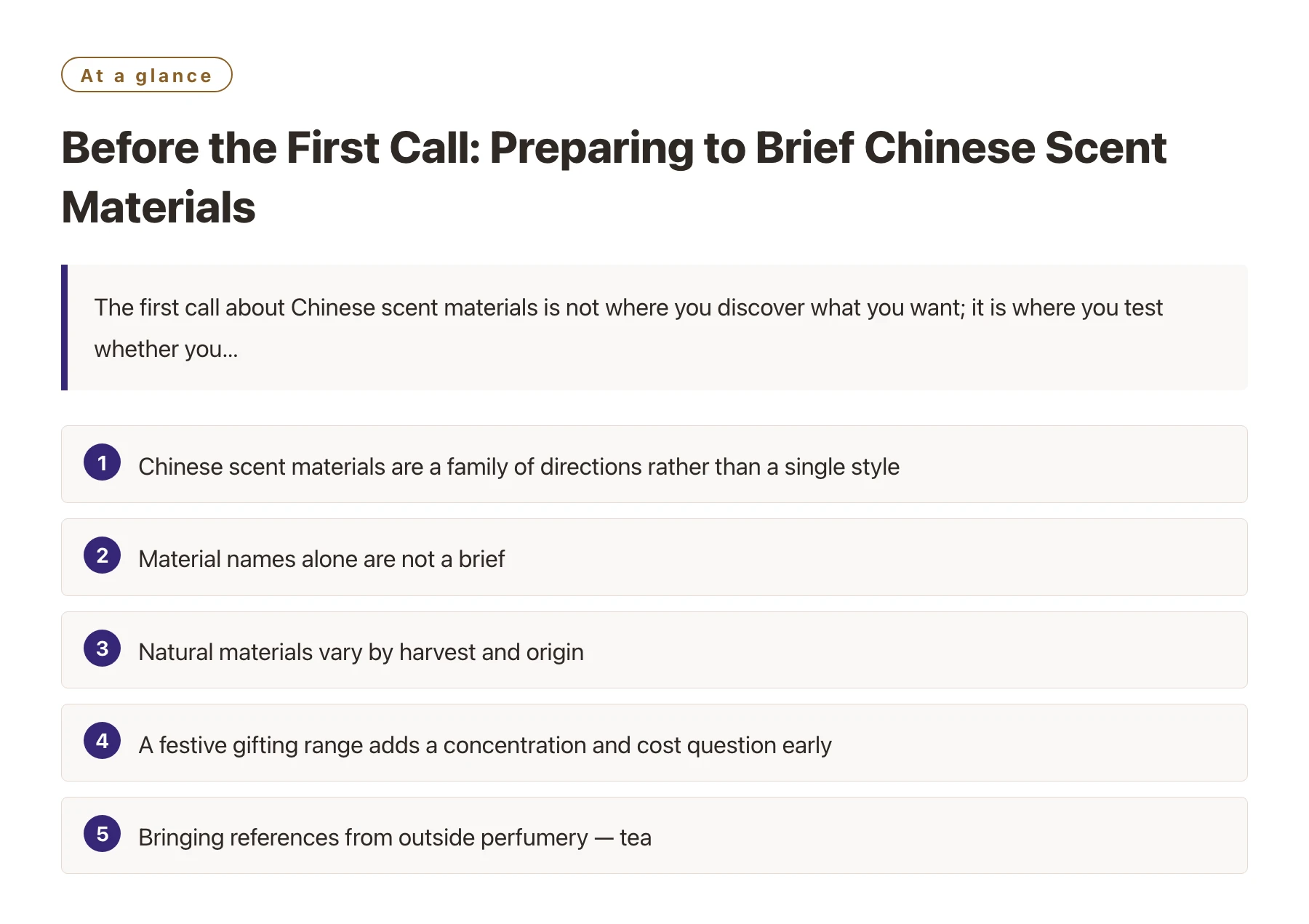
- Chinese scent materials are a family of directions rather than a single style, so the brief should name individual materials and the impression each one is meant to carry.
- Material names alone are not a brief; a supplier needs to know whether the material should read as the centre of the fragrance or as a supporting texture.
- Natural materials vary by harvest and origin, so a brief that depends on a precise natural character should expect a range rather than a single fixed expression.
- A festive gifting range adds a concentration and cost question early, because the same material direction can be built at very different price points.
- Bringing references from outside perfumery — tea, food, wood, a place — is more useful at the first call than a list of competitor products.
There is a particular kind of first call where both sides are enthusiastic and nothing is decided. It ends with a promise to send some samples and a quiet uncertainty about what was actually agreed. The alternative is unglamorous: arrive with four things written down, ask about feasibility, and leave with a defined next step.
This article is about that preparation, specifically for the material directions associated with Chinese perfumery. It is written for a brand owner or creative lead rather than a perfumer, so it avoids technical vocabulary where plain language works better — and it says plainly where the honest answer is that something depends on the material and the dosage.
What Chinese scent materials actually means in a brief
The phrase covers a wide family. It can mean floral directions such as osmanthus or jasmine, tea directions built around green, roasted or floral inflections, resinous and woody directions such as sandalwood and agarwood, and spice directions where cassia and cinnamon bring warmth rather than heat. Each of these can be the centre of a fragrance, or a supporting texture that makes something else feel finished.
That distinction is the first thing to settle, because it changes the whole conversation. A fragrance built around osmanthus is a different project from a fragrance that uses an osmanthus inflection to soften a woody base, even though both would be described in a brief as having osmanthus in them. The reference material for Chinese perfume heritage scents exists in public form, but the more useful preparation is to decide which role each material plays in your idea.
It also helps to be honest about what you are reacting to. Many buyers are drawn to a material because of a specific food, drink or place rather than because of another perfume. That is a strength, and it should go into the brief as a reference rather than being translated prematurely into a material name.
Natural, reconstructed or both
Most commercial fragrances combine natural extracts with reconstructed materials, and the choice is partly a cost question and partly a consistency question. Natural materials vary by harvest and origin, which can be an asset for character and a liability for repeatability. Knowing which side of that trade-off you want is part of the preparation, and it is a question to ask rather than to answer in advance.
A material database is a practical way to prepare for that conversation, because it gives you the vocabulary and the typical uses of an ingredient before you discuss it with a supplier. [1] Reading one entry properly tends to replace several speculative questions with one good one.
The preparation packet: seven items
- Three references, at least one of which is not a perfume: a tea you like, a wood, a place, a dessert. Describe what you like about each in one sentence.
- The role you want the material to play: centre, supporting texture, or finish.
- The format and the festive context, including whether the product is a gift on its own or part of a set.
- The concentration and cost position you are aiming at, in plain terms rather than a number you have invented.
- What you do not want, stated as clearly as what you do want, because exclusions shorten the sample loop.
- The market you are selling into, since labelling and documentation obligations follow the market rather than the scent.
- The decision you need from the call, which is usually feasibility plus a next step rather than a price.
The item buyers forget to prepare
Of the seven items, the market question is the one most often left out, and it is the one that changes the documentation conversation rather than the creative one. Some preparation on how fragrance materials are regulated in your target market shortens that conversation considerably, and formal perfumery education is one route to that understanding when you plan to work with materials repeatedly. professional scent training is a reasonable thing to look into if the material direction is going to be central to your brand rather than a one-off.
It is worth being clear about what that kind of training does and does not do. It will not make you a perfumer in a few weeks, and it should not be treated as a way to brief in technical language. What it does is give you the vocabulary to ask a precise question and to recognise an answer that is vague, which is the actual skill being tested in a first call.
How to use the materials question in the meeting
Ask about role before you ask about price. Once the supplier understands where the material sits in the structure, the cost conversation becomes specific: what has to be dosed, what can be substituted and what the difference would be perceptible as. Asked before that, the price question produces a number that is difficult to use.
Ask what the material will do over time, too. Resinous and woody materials tend to develop differently from light florals, and a festive product may be bought and used weeks or months after it is produced. A supplier who can describe how the direction behaves over time is describing their familiarity with the material rather than a marketing claim.
Ask about the range, not the exact match
If your reference is a natural material, ask what variation is normal and how it will be managed. An answer in terms of a range — a retained reference, a permitted deviation and a discussion if the batch falls outside it — is more credible than an assurance of an exact match, because the exact match depends on a harvest.
The chemistry behind that variation is well documented, and understanding it at a high level improves the questions you ask. [2] You do not need the analytical detail; you need to know that a change in a natural lot is a normal event with a normal control, not evidence of a problem.
Ask who will produce it and where
The material conversation is a good moment to establish where the work will happen. A partner able to formulate and produce in one operation can carry a material direction from bench to line without a transfer, which matters when the festive date is fixed. Asking about Xuelei in that context is asking a practical question about handovers rather than a question about geography.
It is also fair to ask for evidence that they have worked with the material before, in a product comparable to yours. That is a narrower and more useful request than a general list of capabilities, and it produces a concrete follow-up question about dosage, stability and the shipment it went into.
What good preparation changes about the outcome
Preparation does not make the fragrance better; it makes the project faster and the feedback more useful. A partner who receives a role, a reference set, an exclusion list and a date can return a sample that addresses your actual idea, which means the first review is about nuance rather than about whether the direction was understood at all.
It also changes what you learn from comparable projects. If you want to see how a direction has been handled for other brands, looking at the brands behind these scents tells you what kind of work the partner has actually shipped, which is more informative than a description of the approach. Pair that with a defined next step at the end of the call and the first conversation has done its job.
The last piece of preparation is the least comfortable: decide in advance what you will do if the material you wanted is not feasible at your price point. Having a fallback direction written down keeps a good conversation from becoming a stalled project, and it gives the supplier room to propose something better than either of your original options.
One habit worth keeping: after every material conversation, write two sentences — what you asked for and what the material can realistically do. Over three or four projects that note becomes a private reference you cannot buy, and it is the fastest way to stop repeating the same discovery with a new supplier.
Sources
- The Good Scents Company —— A reference database of aroma materials with odour descriptions, CAS numbers and typical usage information.
- American Chemical Society —— A scientific society publishing chemistry research and educational resources, including material on aroma and volatile compounds.
Frequently asked questions
What are the main Chinese scent materials used in modern perfumery?
Common directions include osmanthus, jasmine, tea accords built around green or roasted inflections, resinous and woody materials such as sandalwood and agarwood, and warm spices such as cassia and cinnamon. Most commercial fragrances combine natural extracts with reconstructed materials rather than relying on a single source.
Should I ask for natural materials or reconstructed ones?
Ask for both and describe what you are optimising for. Naturals bring character and variability, while reconstructed materials bring consistency and often a lower cost. The right mix depends on whether the material is the centre of the fragrance or a supporting texture.
How do I write a brief for a scent I can only describe by reference?
Use references and role rather than vocabulary. Name three things you like, at least one of them outside perfumery, say in one sentence what appeals to you about each, and state where the material should sit in the structure. Add an exclusion list; it shortens the sample loop more than any adjective.
Why does a fragrance made with natural materials change between batches?
Because natural extracts vary with harvest, origin and extraction. That variation is normal and is managed through a retained reference and a permitted deviation range rather than eliminated. If a supplier promises an exact match on a natural character across batches, ask how that would be achieved.
What should I leave the first call with?
A feasibility answer, an agreed role for each material, a defined next step with a date, and a note of what changed in your own understanding. If the call ends with only a promise to send samples and no defined question, the preparation was probably incomplete.
Carry something made to outlast the season.
Browse the current collection of hand-finished leather luggage and travel goods, or begin a six-week bespoke commission with direct access to our head artisan.
Shop the Collection